
© creative synergies, Laurent Bailly
Zucchini has changed its status. Once eaten only occasionally, it's now found everywhere: grilled, as vegetable "spaghetti," or even sweet and sour to accompany the traditional raclette. To meet the growing demand, particularly from large retailers (Coop, Migros), cultivation requires meticulous attention. The challenge is twofold: to offer consistent size and impeccable taste, while keeping pace with the plant's natural growth cycle.
An all-in-one operation for sowing and protection
In early May, we deployed a new seeding machine. Attached to one of our tractors, it performs all the operations in a single pass: laying the mulch, installing the drip irrigation system, and sowing the seeds. The mulch serves two purposes: it smothers weeds and limits water evaporation, thus reducing the need for weeding and watering. The machine then precisely pierces the plastic to allow the seedlings to emerge in the center of the mulch. "We do everything in one go," summarizes Christophe Stoll. "It's a considerable time saver given the size of our fields.".
Health monitoring, between technology and manual maintenance
Courgette is very susceptible to fungal diseases, such as powdery mildew and downy mildew. We must remain vigilant throughout the season, as each harvest cut leaves a wound on the stem, providing numerous potential entry points for infections.
For weeding, we use the Ecorobotix robot as long as the plants are small enough for the machine to pass between the rows. Equipped with cameras and artificial intelligence, this robot identifies weeds and applies a highly localized herbicide treatment, only to the unwanted plants, thus sparing the soil and the crop.
Once the vegetation has developed, the strategy changes. An initial mechanical scraping of the soil eliminates weeds, then the regular passage of our teams for harvesting is enough to trample the soil to slow down new growth.
Finally, there remains one strictly manual task: leaf removal. "During harvesting, we also cut off the old lower leaves. They no longer perform much photosynthesis and even consume the plant's energy in their decomposition process," explains Christophe. "By removing this unnecessary weight, we relieve the plant and allow it to produce new fruit."«
The race against time of the caliber
The major challenge with this vegetable is its rapid growth. "One day too long, and they're already out of size," warns the crop manager. A zucchini that isn't harvested in time becomes waterlogged, develops large seeds, and grows a thick skin, thus becoming unsaleable. Harvesting must take place at least six days a week to meet standards.
To make the work easier for our employees, we use specific equipment: a harvesting conveyor mounted on an articulated arm. This conveyor lifts the full crates directly into the truck, eliminating the need to carry heavy loads. An onboard scale allows us to weigh the crates on-site, so they are ready to be shipped to the customer without any additional handling at the warehouse.
Choosing the right variety: a fundamental task
Beyond size at harvest, it's the plant's genetics that dictates the success of the crop. At Stoll Frères, we regularly test different types of zucchini to evaluate their productivity and field performance: disease resistance, plant shape, absence of thorns, and storage potential. Once these technical criteria are validated, we select the varieties that offer the best taste and the desired color.
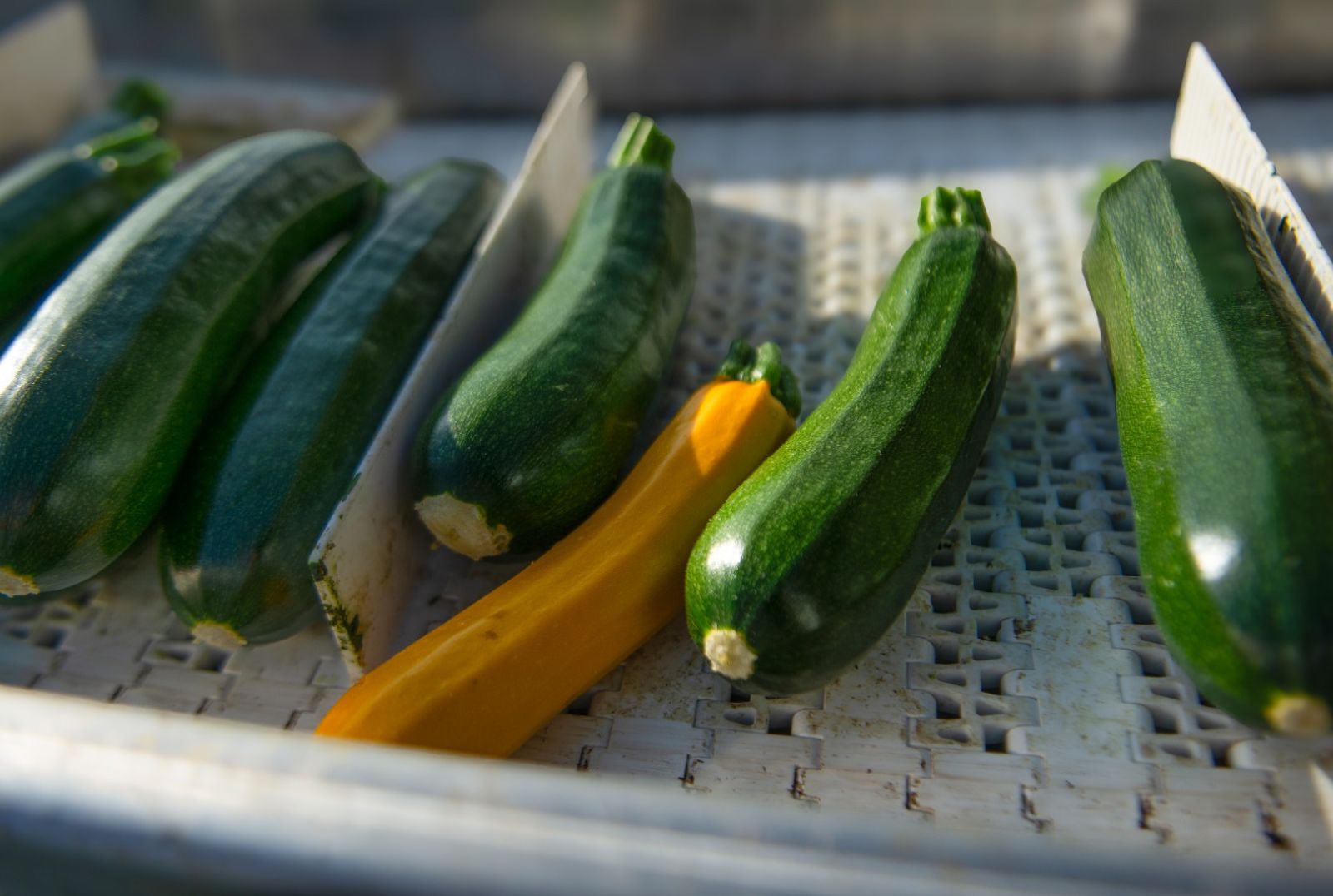
Our current selection includes green and yellow courgettes. In addition to their appearance and flavor, the yellow courgettes play a useful role in the fields: their flowers attract pollinators and promote fertilization of all the plants. They are therefore strategically placed among the rows of green courgettes to accelerate the natural process.
A well-tended plant can yield between 10 and 15 courgettes. Sowing in May will allow us to harvest the first crops before mid-June. We will then sow again throughout the summer to ensure a continuous supply of Swiss produce until the end of the season in September.