
Between Asia, Africa, and Europe, the eggplant has been traveling from one cuisine to another for nearly two millennia: Indian baingan bharta, Chinese yuxiang qiezi, Levantine baba ganoush, Ivorian akpessi, Romanian zacuscă, Greek moussaka, and Italian parmigiana. Grilled, roasted, fried, or smoked, its meltingly tender flesh absorbs seasonings and lends itself to a multitude of preparations.
«"Eggplant never leaves anyone indifferent. As soon as you talk about it, everyone has a recipe, a travel memory or a favorite way to cook it," notes Julien Stoll, director of greenhouse production at Stoll, where some 400 tons of this fruit-vegetable are harvested each year.
Violet, white, green… a variety of faces and flavors
In Switzerland, the most common eggplant is purple and slightly elongated. But it's far from the only variety. Some are long and thin, often associated with Chinese and Japanese cuisine. Others are striped with purple and white, mauve, or entirely white, and are long, oval, or almost round. Some Thai curries also include "pea eggplants," tiny green fruits with a bitter flavor. In Africa, some related species produce round or oval fruits that can turn orange when ripe.
The name itself tells a story of travel. The French word "aubergine" comes from Catalan, itself derived from Arabic, with even older roots in Persian and Sanskrit. While the Italian "melanzana" is often described as coming from the Latin "mala insana," meaning "unhealthy fruit," it actually seems to also originate from Arabic. As for the English "eggplant" or the German "Eierfrucht," the origin of the word is more obvious, since it directly refers to the shape of the fruits, which resemble eggs.
Are eggplants really bitter?
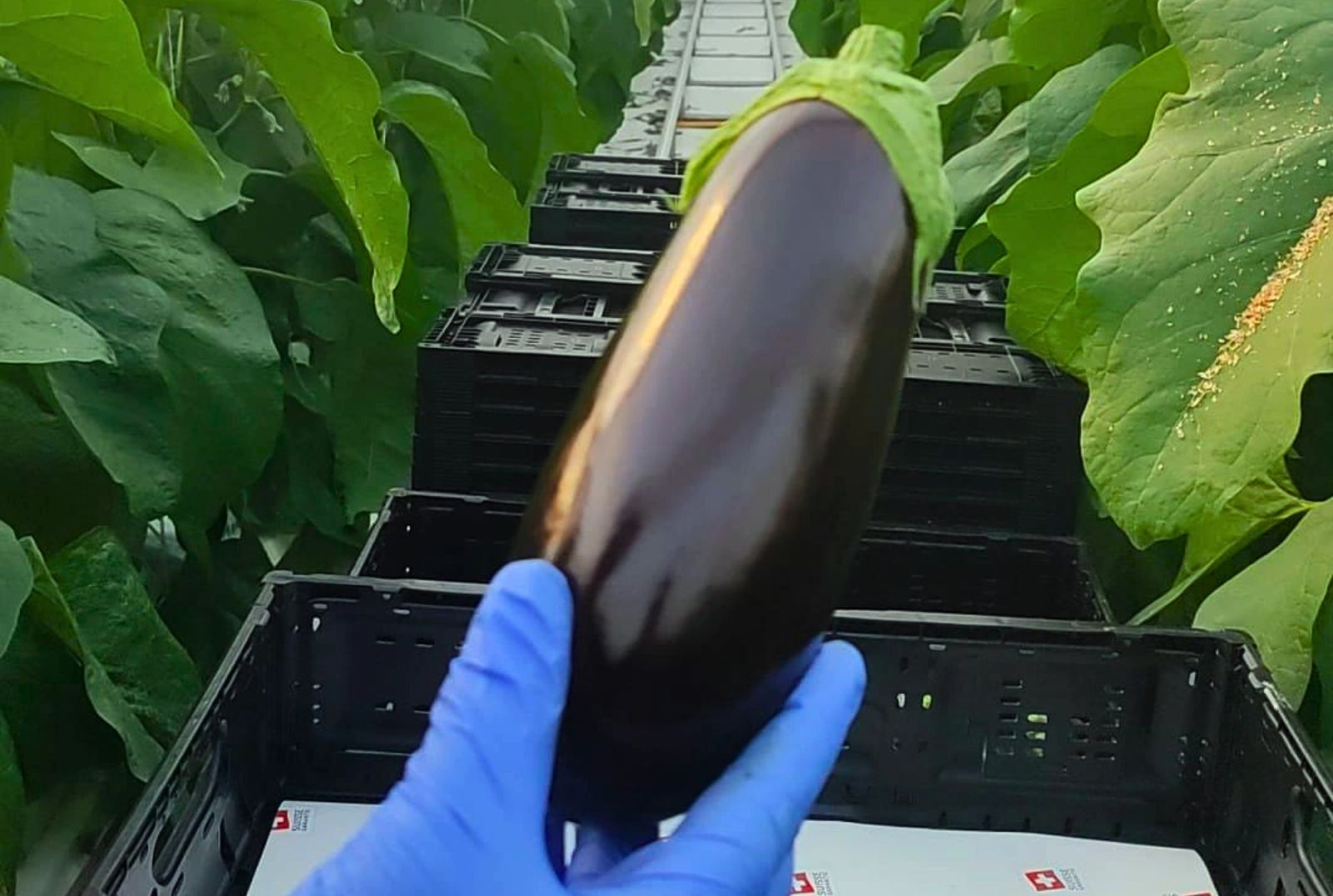
Bitterness depends primarily on the choice of variety. "We select varieties with low bitterness, which correspond to the taste sought by our customers. It is precisely these purple, slightly elongated, firm and shiny eggplants that we grow in our greenhouses and that are generally found in supermarkets," explains Julien Stoll.
Growing conditions and harvest time also influence fruit quality, both in terms of texture and taste. High temperatures, water stress, or disease can lead to a more bitter flavor. A late harvest will also result in fruit with more seeds, a thicker skin, and a more pronounced bitterness.
«By growing in greenhouses and on substrate, we precisely control the irrigation and nutrition of the plants, while monitoring their health and protecting them against pests,» explains Julien Stoll. Harvesting them at the right time is also crucial. That’s why our teams work six days a week.
In the store, a few clues help to choose a good eggplant: smooth and shiny skin, firm flesh and a peduncle that looks fresh.
Should you salt the eggplants to remove excess moisture?
Salting eggplants is traditionally associated with reducing their bitterness. With the varieties commonly sold in Switzerland today, this step is rarely necessary.
However, degreasing still has culinary benefits. The salt draws out some of the water contained in the flesh and alters its texture. Depending on the desired cooking method, this step can also contribute to a better charred surface.
More than a month to enjoy!
While eggplant is often associated with summer, at Stoll, the harvest extends from early March to the end of October. There's still time to enjoy local eggplants and perhaps try one of the many culinary specialties to which this fruit-vegetable lends itself so well.
To learn more about this crop and discover the work of our teams, follow in the footsteps of the head of the eggplant greenhouse, Rafal Krupa, in this profile: https://stoll-freres.ch/fr/rencontre-avec-rafal-krupa-responsable-de-la-serre-daubergines/