
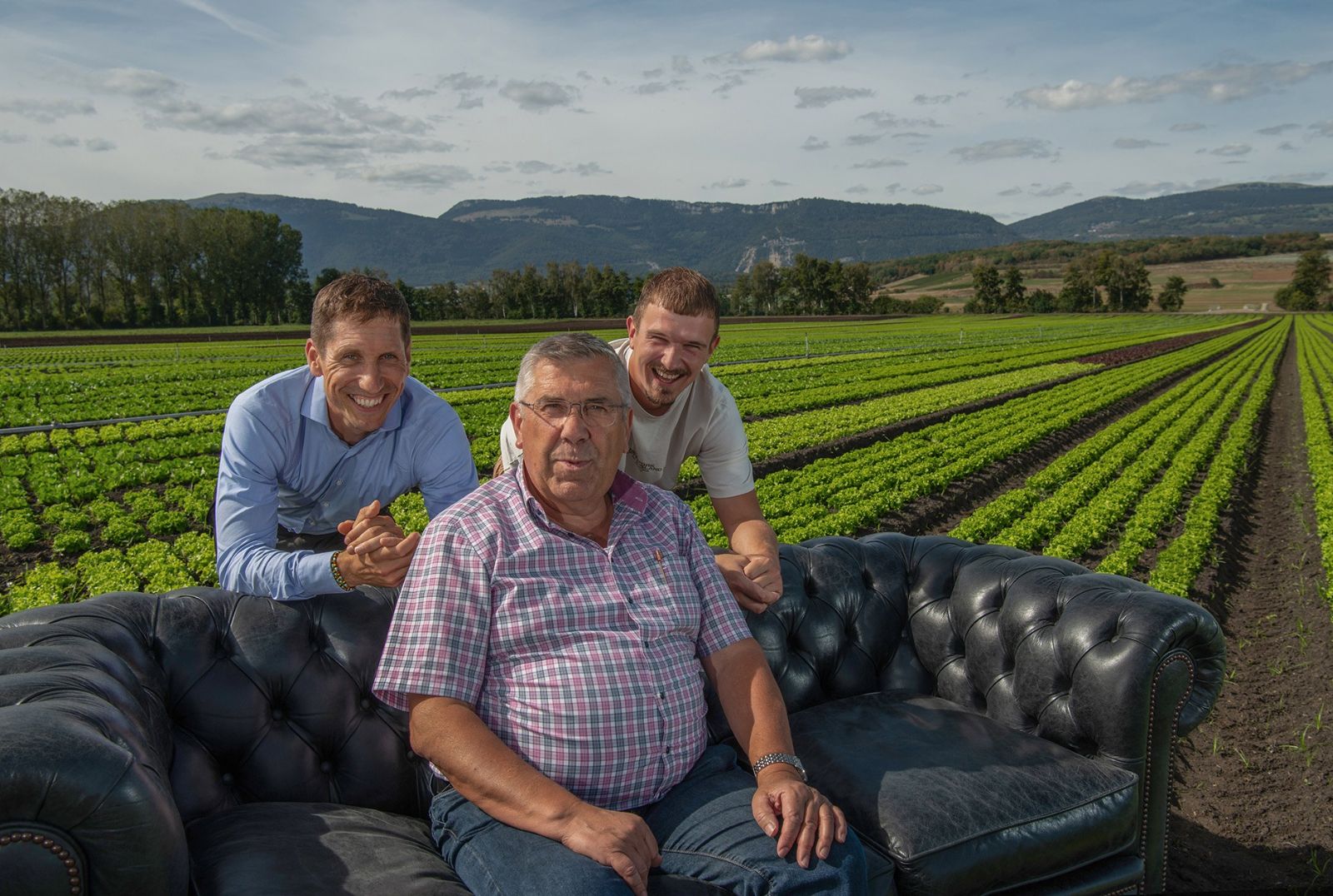
This handover is now official. What does this change in practical terms?
Roland Stoll: The roles are now formalized. I remain chairman of the board, Julien becomes CEO, and Christophe production director. But in reality, the transition began several years ago. They gradually took on more responsibilities, and it was important that this happen over time.
Julien StollFor us, it is obviously a great source of pride. We feel a strong responsibility to preserve what has been built, but also the freedom to write the next chapter with our own priorities to give the company the means to evolve.
The company has always had a very entrepreneurial culture. How do you plan to continue this?
Julien Stoll: We grew up in a company that has always invested, tested new methods, and sought to anticipate changes in market gardening. It's a way of working that we want to maintain: try, measure, adjust, sometimes make mistakes, but always move forward.
Christophe Stoll: Right now, we're investing in new infrastructure and continuing to regularly test crops and new technologies. Innovation is very important to us. And so is pragmatism: market gardening remains a very concrete profession, with the rhythm of the seasons and realities that cannot be ignored.
Collaboration with other producers also plays an important role in your vision. Why?
Christophe Stoll: Because there are many issues on which we have an interest in working together. We are all three involved in different organizations in the sector: Roland at the Swiss Vegetable Growers' Union, Julien at the Vegetable Technical Office, and myself at the Vaud Federation of Vegetable Producers.
Roland Stoll: We realized quite early on that we couldn't each do everything on our own. With a highly concentrated distribution network and complex issues, a single producer has little influence. That's also why we started forming alliances in the mid-2000s.
Julien Stoll: And today, we want to continue participating in existing structures, but also create new collaborations when it makes sense. We remain competitors, of course, but on technical issues, purchasing, innovation, or industry advocacy, we have every interest in sharing our experiences and seeking common solutions.
You also wish to continue the dialogue with political and community groups. On what topics?
Julien Stoll: For all those who have a concrete impact on our profession. A regulatory decision can completely change farming methods or necessitate significant investment. It is therefore essential that the realities on the ground be heard.
The issue of greenhouses is a good example. Protected facilities reduce the use of pesticides and conserve water. However, building new infrastructure of this type has become virtually impossible. If Switzerland wants to continue producing its vegetables locally according to high standards of efficiency and sustainability, it must also enable producers to adapt their production methods.
With approximately 200 employees, the company's attractiveness is also a major issue. Where do you want to focus your efforts?
Christophe Stoll: Market gardening is labor-intensive, even with increasing mechanization. Therefore, it is essential to remain attractive by tangibly improving working conditions.
Julien Stoll: In recent years, we have improved several aspects of our work, including salaries, working hours, ergonomics, and seasonal accommodation. Our goal is to continue in this direction.
You often use the word «resilience». What does it mean to you?
Christophe Stoll: A company like ours shouldn't depend on just a few people; it must be able to continue functioning even if one of us is absent. That's precisely why we're evolving our organization, by better distributing responsibilities and giving teams more autonomy.
Julien Stoll: Our handover follows the same logic. Roland gradually delegated more responsibilities to us, while remaining involved to guide the transition. Christophe and I are of different ages and have different career paths, and we are at different stages of our professional lives. This difference allows us to build a long-term succession plan.
Roland, what do you want to pass on to them beyond the company itself?
Roland Stoll: The company has always evolved, and that's also the mindset I want to pass on to them: a taste for experimentation, the ability to break the mold when necessary, and a willingness to work with others, always keeping their feet on the ground. Now it's up to them to bring all of this to life in their own way.