
© creative synergies, Laurent Bailly
The quest for the perfect bunch
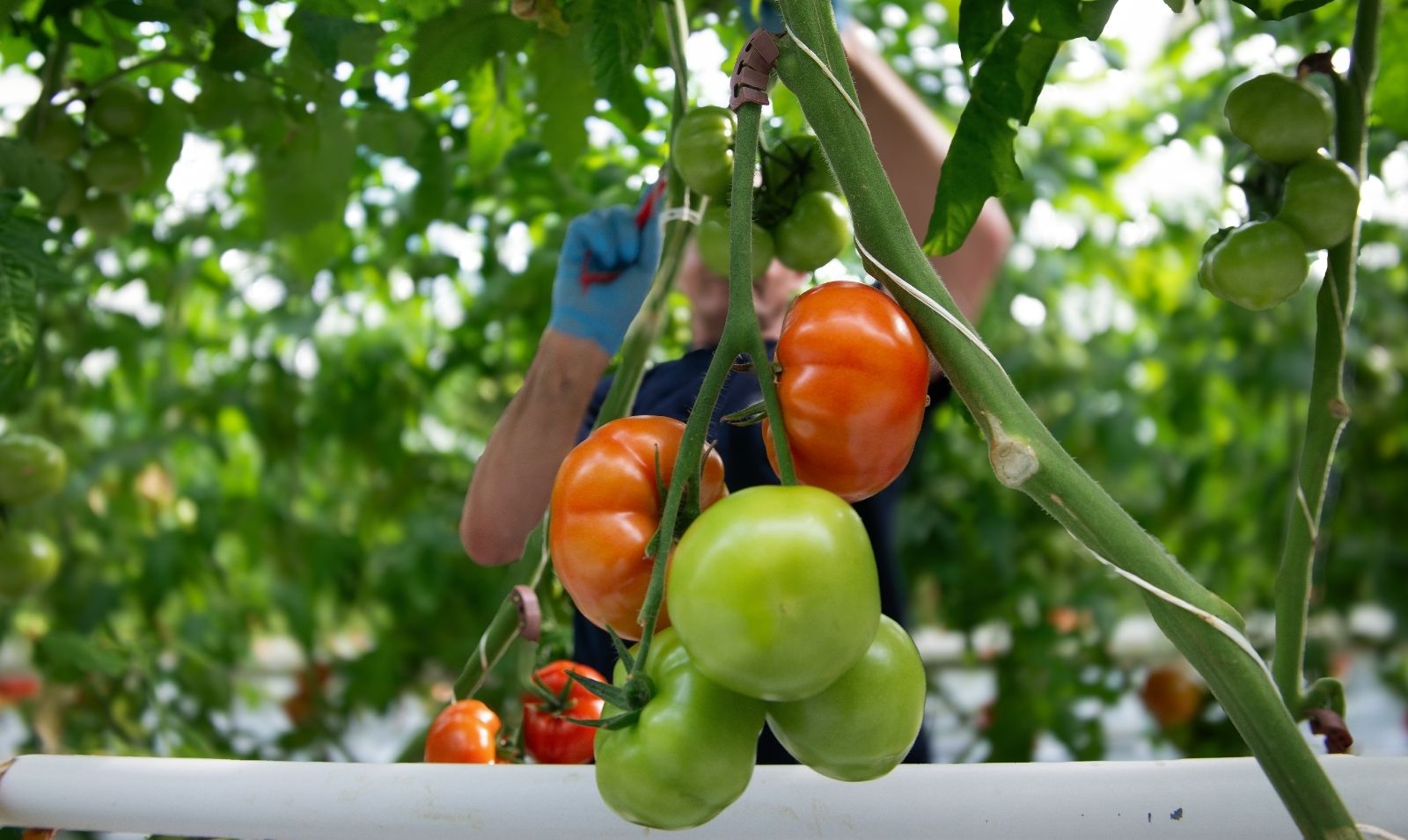
«The challenge is timing,» explains Julien Stoll, Director of Greenhouse Production. Harvesting at the right moment, neither too early nor too late, is crucial. For cluster tomatoes, picked all at once, nature complicates matters further, as more than a week passes between the time the first and last fruit ripen.
So how do you get those beautiful, uniform bunches of fruit that you usually find on store shelves? "To achieve this, we select productive varieties capable of bearing twelve fruits per bunch, then we remove the bottom half as soon as they flower," he explains. With this rigorous selection process, the 5 to 6 tomatoes that will set fruit will ripen in just a few days and will all be perfectly flavorful and firm at harvest time.
Forecasts are adjusted weekly.
Ana Maria Costea, Production Coordinator, has been responsible for several years for establishing harvest forecasts for all greenhouse crops. "On January 5th, when we do the first plantings, we already have a general idea of the schedule. But the reality requires more precise reassessments every week," she explains.
The accuracy of this planning is vital: it allows us to size the teams, avoid surpluses or shortages of goods, and to harvest the fruits at the ideal time.
A promising AI-based copilot
A ritual is repeated every Thursday morning: equipped with "clickers," teams walk through the rows and, with a practiced eye, estimate the quantities to be harvested the following week. "I receive the raw figures, I enter them into a spreadsheet and I make the forecasts for each variety. It's quite quick," explains Ana Maria.
Recently, an artificial intelligence solution has been generating its own forecasts, based on data collected directly from the plants (flowering, fruit set, temperatures, etc.). "We are in the testing phase," she explains. "I compare my results with those of the AI, and we hope it will be completely reliable by next season."«
The stakes are high: to make harvest forecasts three weeks in advance, instead of one week as is currently the case. "This will allow us to align production and sales even more precisely," Julien assures.
Behind these planning challenges lies the desire to better meet customer expectations, for whom anticipation is essential. Technology is proving to be a valuable ally in supporting the work of teams.
Want to learn more about our tomatoes and our growing methods?